

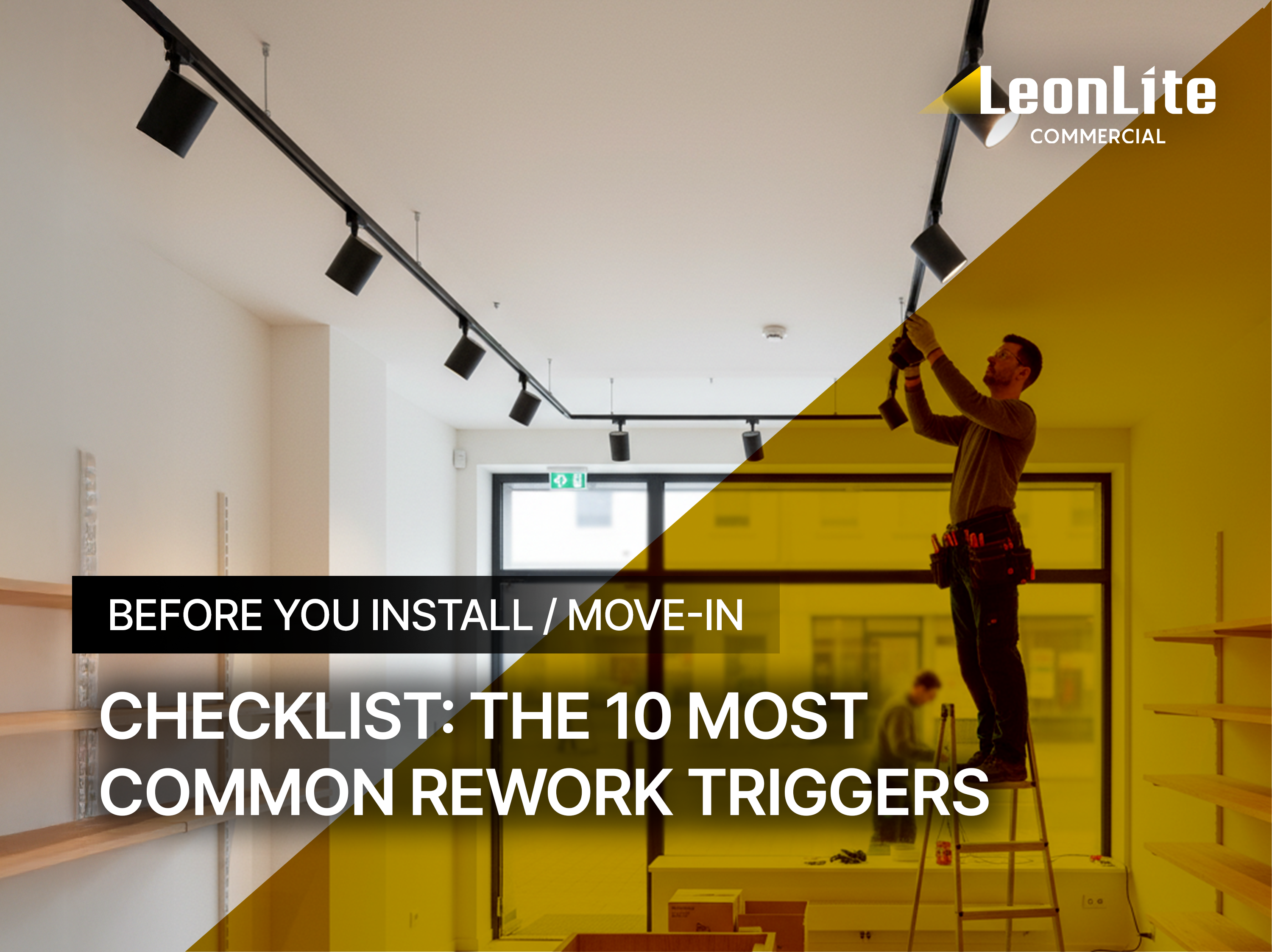
In commercial lighting projects, rework is never just “one more visit.” It often leads to repeat labor, schedule delays, area closures, customer complaints, warranty disputes, and even safety risks. And the most frustrating part? Many rework issues aren’t caused by product failure—they happen because critical steps were missed the first time.
Below are the 10 most common rework triggers that account for the majority of problems in warehouses, factories, retail spaces, parking garages, offices, and similar commercial sites.

1. Site Conditions Not Verified: Height, Beams, Utilities, Obstructions
What happens: Fixtures get blocked by beams, light levels fall short, access panels can’t open, or conflicts arise with sprinklers/ducts/cable trays.
Prevent it by:
• Doing a pre-install site walk and re-measurement.
• Marking obstructions (beams, ducts, sprinklers, trays) and maintenance clearances.
Acceptance check: Mounting points support both coverage and service access.
2. Wrong Optics / Distribution: Missed Targets, Glare, Shadow Zones
What happens: Same wattage, different optics—result: poor uniformity, dark spots, or excessive glare.
Prevent it by:
• Using IES photometric layouts to confirm spacing, optics, and mounting height.
• Defining target illuminance (lux/foot-candles) and glare limits where applicable.
Acceptance check: Mounting points support both coverage and service access.
3. Driver / Dimming Incompatibility: Flicker, No Dimming, Early Failures
What happens: 0–10V, DALI, PWM, and Triac systems get mixed or mismatched, causing flicker or control failure.
Prevent it by:
• Locking the control protocol and compatibility list before ordering (driver + dimmer + controls).
• Testing a small sample install (1–2 fixtures) before scaling.
Acceptance check: Smooth dimming across the full range with no flicker or dropouts.
4. Undefined Sensor / Control Strategy: False Triggers, Always-On, Complaints
What happens: Occupancy sensors misread forklifts, daylight settings are off, lights cycle too often, or never shut off.
Prevent it by:
• Defining detection zones, timeouts, thresholds, and zoning logic in advance.
• Assigning a clear owner for commissioning/tuning (avoid finger-pointing later).
Acceptance check: Run at least three real scenario tests (occupied/unoccupied, day/night, forklift pass-through).
5. Wiring and Polarity Errors: Dead Fixtures, Tripping, Burned Drivers
What happens: Loose terminations, missing ground, incorrect polarity, and weak crimps create intermittent failures or damage.
Prevent it by:
• Using standardized wire color coding and quality connectors.
• Following torque and crimp standards consistently.
Acceptance check: Randomly inspect termination tightness, insulation integrity, and grounding continuity.
6. Wrong IP / Environmental Rating: Early Failure in Moist, Dusty, or Greasy Areas
What happens: Indoor fixtures get installed in damp, dusty, corrosive, or cold-storage environments—leading to condensation, water ingress, rust, and premature failure.
Prevent it by:
• Classifying the environment (moisture, dust, corrosion, condensation, salt air).
• Matching the right IP/IK ratings and corrosion-resistant construction.
Acceptance check: Confirm the site is zoned correctly—no “one-size-fits-all” spec.
7. Incorrect Mounting Hardware / Method: Loose Fixtures, Drop Hazards
What happens: Anchors are mismatched, structure isn’t rated, vibration loosens hardware—creating safety hazards.
Prevent it by:
• Confirming load ratings, mounting structure, and anti-vibration requirements.
• Adding safety cables/secondary retention in higher-risk areas.
Acceptance check: Verify mounting torque, load capacity, and secondary safety measures.
8. CCT / CRI / Batch Mismatch: Visible Color Differences on Site
What happens: Different production batches or mixed specs create noticeable “one area looks warmer/cooler” effects.
Prevent it by:
• Keeping the same batch for the same space whenever possible.
• Specifying CCT/CRI and SDCM (color consistency tolerance) requirements.
Acceptance check: Within the same line of sight, color differences are not visibly noticeable (instrument spot-check if needed).
9. CCT / CRI / Batch Mismatch: Visible Color Differences on Site
What happens: No defined install window, aisles get blocked unexpectedly, production or retail operations are impacted—forcing expensive nighttime rework.
Prevent it by:
• Aligning the install plan with operations and shift schedules early.
• Phasing work by zone and maintaining safe access routes.
Acceptance check: Each work zone has a defined closure area, timeframe, and owner.
9. CCT / CRI / Batch Mismatch: Visible Color Differences on Site
What happens: No defined install window, aisles get blocked unexpectedly, production or retail operations are impacted—forcing expensive nighttime rework.
Prevent it by:
• Aligning the install plan with operations and shift schedules early.
• Phasing work by zone and maintaining safe access routes.
Acceptance check: Each work zone has a defined closure area, timeframe, and owner.
10. No Closeout/Commissioning Checklist: Issues Surface After Handover
What happens: “It turns on” is treated as completion—while illuminance, emergency lighting, control integration, and labeling aren’t verified.
Prevent it by:
• Using a simplified closeout checklist: light level spot-check, dimming test, sensor test, emergency test.
• Recording photos/data to reduce warranty disputes.
Acceptance check: A basic set of test records is included in the turnover package.

Share:
Trimless Downlights as a Pre-Move-In Design Decision
Retrofit Lighting Applications: How to Upgrade Existing Recessed Fixtures with Less Complexity