

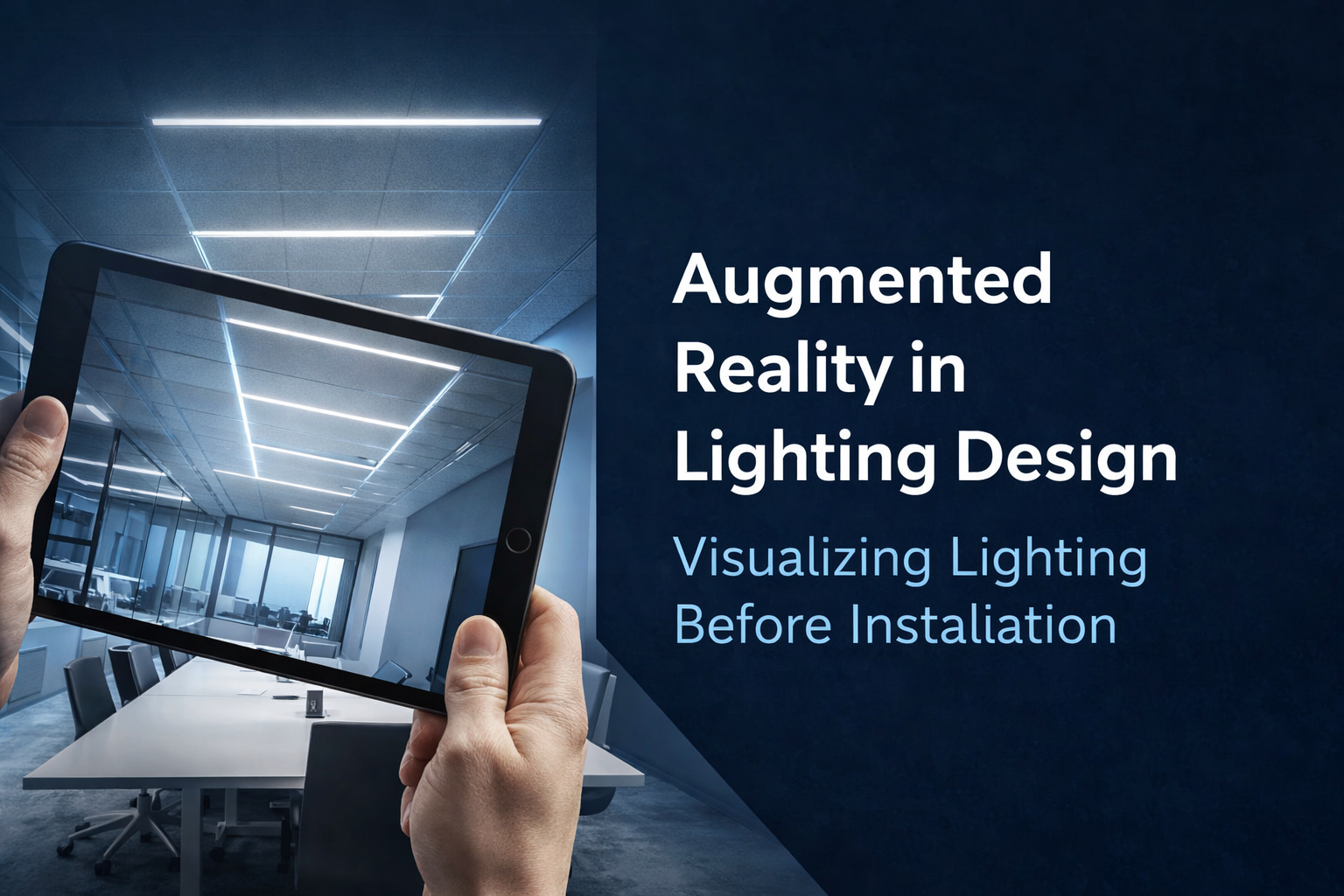
Augmented reality is becoming a practical tool in commercial lighting design because it allows architects, lighting designers, and contractors to visualize fixtures in real spaces before installation begins. In office, hospitality, retail, and multifamily projects, this can reduce layout uncertainty, improve coordination with other trades, and help teams make faster specification decisions.
For general contractors, AR is not just a presentation tool. It can help identify fixture placement issues early, reduce change orders, and improve installation planning when lighting must align with ceiling grids, HVAC, sprinklers, and other building systems.

Why Lighting Visualization Matters in Construction Projects
Lighting is one of the most frequently revised elements in commercial construction. During traditional project workflows, lighting plans are typically developed using 2D drawings or static renderings. While these methods provide basic guidance, they often fail to fully represent how light will interact with real architectural environments.
This can lead to several common problems that concern contractors and developers:
-
Lighting fixtures placed incorrectly during installation
-
Poor illumination levels in key areas such as offices or corridors
-
Conflicts between lighting layouts and HVAC or ceiling systems
-
Costly redesigns after construction begins
Augmented reality helps solve these issues by allowing teams to see lighting systems in real space before installation begins.
How Augmented Reality Improves Lighting Design Accuracy
Using AR visualization tools, designers can project digital lighting fixtures into physical spaces through tablets, smartphones, or AR headsets. This allows the entire project team—including architects, engineers, and contractors—to evaluate lighting performance within the actual architectural environment.
AR simulations can show:
-
Fixture placement within ceilings and structural elements
-
Light distribution across floors, walls, and workspaces
-
Shadow behavior caused by architectural features
-
Overall visual balance of ambient and task lighting
For contractors, this early visualization significantly reduces the risk of installation mistakes or design revisions later in the project timeline.
Where AR Adds the Most Value in Commercial Lighting Projects
AR-based lighting visualization is especially useful in commercial projects where fixture placement and visual consistency matter. Common applications include:
-
Office renovations, where teams need to verify linear lighting layouts within existing ceiling conditions
-
Hotel lobbies and hospitality spaces, where lighting must support both architectural design and guest experience
-
Retail environments, where beam spread, accent lighting, and fixture positioning affect product presentation
-
Multifamily corridors and amenity spaces, where consistent illumination and clean architectural integration are important
-
Corporate interiors, where recessed and suspended luminaires must coordinate with ceiling systems and mechanical layouts
Practical Benefits for General Contractors
From a construction management perspective, AR-based lighting planning provides several measurable advantages.
Reduced Design Revisions
By visualizing lighting layouts before installation, project teams can identify potential issues early. This reduces the number of design revisions and change orders during construction.
Faster Decision-Making
Contractors often need to coordinate lighting layouts with ceiling grids, mechanical systems, and other building infrastructure. AR simulations help stakeholders quickly evaluate design options and approve lighting specifications.
Improved Coordination Between Trades
Lighting fixtures must often integrate with multiple building systems. AR tools make it easier to ensure that lighting plans align with HVAC ducts, sprinklers, and ceiling structures before installation begins.
Lower Construction Costs
By preventing installation errors and reducing redesign work, AR visualization can help minimize delays and avoid unnecessary labor costs.
How AR Is Used in Commercial Lighting Projects
AR technology is now being integrated into several stages of lighting design and construction.
Design Visualization
Architects and lighting designers use AR to test different fixture types, beam angles, and lighting layouts directly within a physical space.
Client Presentations
Developers and building owners can experience lighting concepts in real scale before construction begins, making it easier to approve design decisions.
Installation Planning
Contractors can overlay lighting layouts onto real ceilings or walls, ensuring accurate fixture placement during installation.
Practical Steps for Implementing AR in Lighting Projects
For construction teams interested in using AR visualization, the process is becoming increasingly accessible.
1. Start with Digital Lighting Models
Lighting layouts should first be created using standard design software such as BIM or lighting simulation tools. These models serve as the foundation for AR visualization.
2. Use AR Visualization Platforms
Several platforms allow lighting models to be viewed in augmented reality through tablets or AR headsets. These tools can project digital luminaires into real architectural spaces.
3. Evaluate Lighting Performance On-Site
Project teams can walk through the space while viewing the AR simulation, allowing them to evaluate fixture placement, light distribution, and potential conflicts with other systems.
4. Finalize Lighting Specifications
Once the lighting design has been validated through AR visualization, contractors can proceed with procurement and installation with greater confidence.

Why Architectural and Linear Lighting Systems Work Well with AR
As AR visualization becomes more common in commercial lighting workflows, the fixtures themselves need to support clean architectural integration. Linear lighting, recessed luminaires, and modular systems are especially effective in AR-based planning because they align closely with ceiling grids, structural lines, and spatial geometry.
This makes it easier for project teams to evaluate fixture spacing, visual rhythm, light distribution, and coordination with surrounding building systems before installation begins. For contractors and specifiers, lighting systems that are simple to visualize and easy to integrate can reduce uncertainty throughout both design review and field installation.
How Leonlite Commercial Supports AR-Ready Lighting
Workflows
At Leonlite Commercial, we understand that modern commercial lighting projects require more than just fixtures—they require systems that are easier to specify, visualize, and integrate into real architectural environments. Our commercial and architectural lighting solutions are designed to support project teams working with BIM models, digital layouts, and AR-based visualization workflows.
For projects that rely on accurate planning before installation, architectural linear lighting and other clean, specification-friendly luminaires can make visualization more effective and installation more predictable. That is why Leonlite Commercial focuses on lighting solutions that support architectural alignment, practical coordination, and contractor-friendly execution across commercial spaces.
If your team is exploring more efficient ways to validate lighting layouts before construction, Leonlite Commercial can help you choose lighting systems that are better suited for modern visualization-driven workflows.

Share:
Stop Reading the Full Code: What GC‘s Actually Need to Care About